Data article from ExporterIQ. Import values in US dollars, 2025 unless marked.
The 15 largest drinks buyers in West Africa and Cameroon import about $700m a year, and Côte d'Ivoire, Ghana and Cameroon take more than half of it. Drinks here means water, soft drinks, beer, wine, vermouth, cider and spirits. Industrial ethanol and vinegar are left out.
Key findings
- Côte d'Ivoire ($144.0m) and Ghana ($139.1m) lead. Cameroon is third at $90.3m on partner-reported figures, because Cameroon does not report its own imports.
- Nigeria is fourth at $63.7m, well below what its population suggests. It also imports $109.6m of industrial ethanol, more than its drinks bill.
- Europe is the main source. Spain supplies about $117m and France about $104m across these markets, mostly wine and spirits.
- Each market has its own taste. Wine leads in Côte d'Ivoire, Togo and Cameroon, spirits in Nigeria, soft drinks in Mali and Mauritania, beer in Senegal.
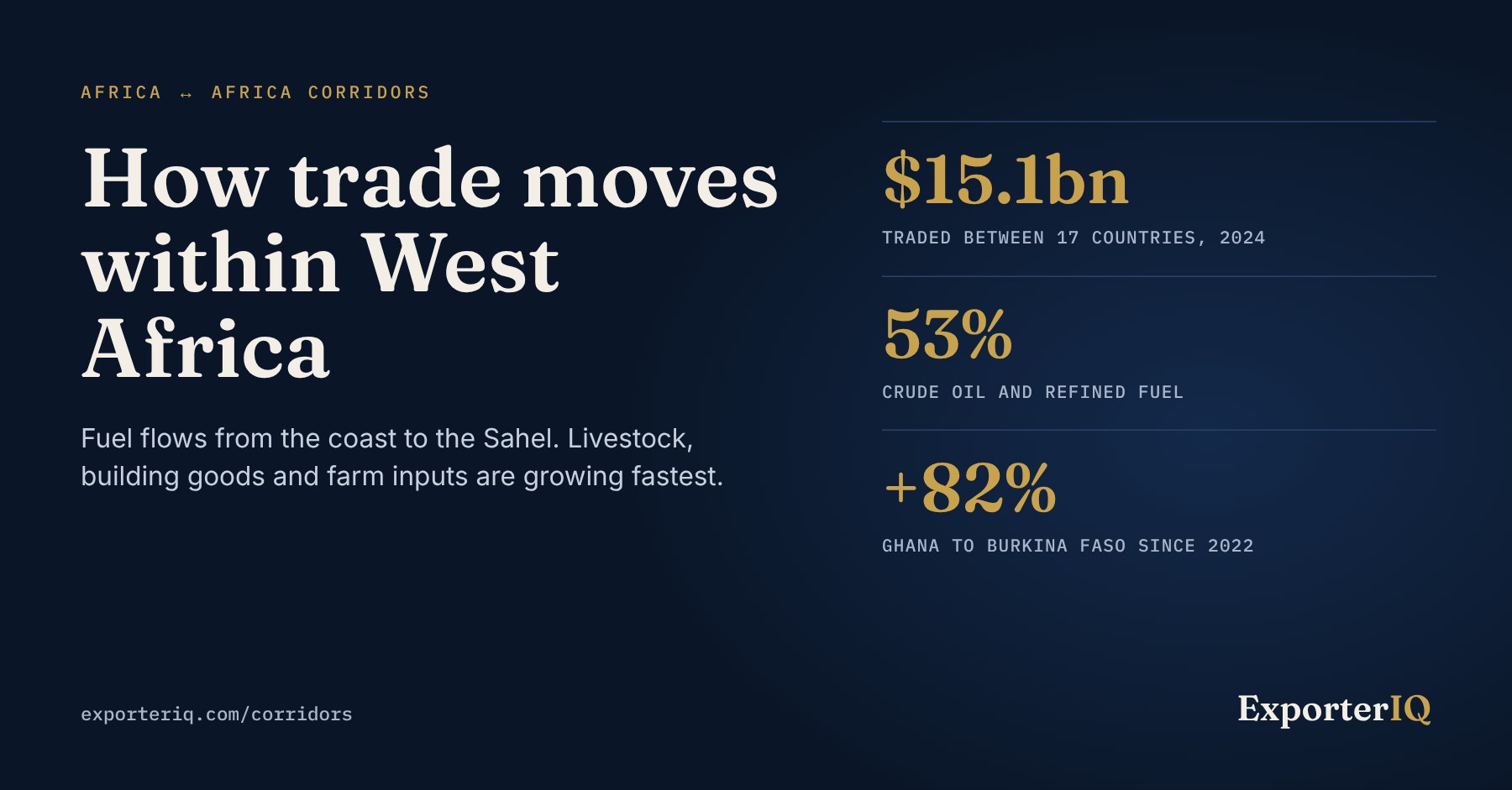
- Trade between African countries is almost all soft drinks. Nigeria sends Ghana $12.9m, Senegal and Burkina Faso send Mali $16.2m, and Ghana sends Togo $6.1m.
The 15 largest importers
Nigeria, the region's most populous country, ranks fourth. Its drinks imports are less than half of Ghana's. "Mirror" means reported by exporting countries, because the importer reports nothing. "2024" means the latest year the country reported.
| Rank | Market | Drinks imports, US$m |
|---|---|---|
| 1 | Côte d'Ivoire | 144.0 |
| 2 | Ghana | 139.1 |
| 3 | Cameroon (mirror) | 90.3 |
| 4 | Nigeria | 63.7 |
| 5 | Guinea-Bissau (mirror) | 44.1 |
| 6 | Guinea (mirror) | 39.2 |
| 7 | Togo | 36.2 |
| 8 | Mali (2024) | 28.7 |
| 9 | Senegal | 25.3 |
| 10 | Cabo Verde (2024) | 23.5 |
| 11 | Sierra Leone (mirror) | 21.5 |
| 12 | Benin (2024) | 14.0 |
| 13 | Liberia | 12.2 |
| 14 | Burkina Faso (2024) | 11.7 |
| 15 | Mauritania | 6.7 |
What each market buys
Half of Côte d'Ivoire's drinks imports are wine, while Ghana splits almost evenly between soft drinks and spirits. Shares are of each country's own drinks imports.
| Market | Largest line | Second | Third |
|---|---|---|---|
| Côte d'Ivoire | Wine, 51% ($72.9m) | Soft drinks, 24% | Beer, 15% |
| Ghana | Soft drinks, 36% ($49.4m) | Spirits, 35% ($49.0m) | Wine, 18% |
| Nigeria | Spirits, 52% ($33.4m) | Soft drinks, 37% | Wine, 9% |
| Togo | Wine, 37% ($13.5m) | Soft drinks, 27% | Spirits, 25% |
| Mali (2024) | Soft drinks, 68% ($19.4m) | Beer, 19% | Wine, 6% |
| Senegal | Beer, 51% ($13.0m) | Soft drinks, 25% | Wine, 13% |
| Cabo Verde (2024) | Beer, 37% ($8.8m) | Soft drinks, 29% | Wine, 19% |
| Benin (2024) | Beer, 35% ($4.9m) | Soft drinks, 22% | Wine, 22% |
| Liberia | Soft drinks, 49% ($6.0m) | Wine, 19% | Beer, 15% |
| Burkina Faso (2024) | Beer, 39% ($4.6m) | Wine, 24% | Soft drinks, 22% |
| Mauritania | Soft drinks, 90% ($6.0m) | Spirits, 6% | Wine, 1% |
For the four countries without their own reports, the partner data shows the same pattern: wine is the largest line for Cameroon (France alone sends $29.5m), beer for Guinea (Denmark sends $10.6m), and Portuguese goods dominate Guinea-Bissau.
Where it comes from
Europe supplies most of the wine, beer and spirits, but each market leans on a different country. Values are US$ millions of drinks imports.
| Market | Leading origins |
|---|---|
| Côte d'Ivoire | Spain 61.0, Germany 18.2, France 14.2, China 6.7, Denmark 4.4 |
| Ghana | Belgium 23.6, Spain 16.2, India 14.5, Nigeria 13.1, France 12.7, United Kingdom 10.9 |
| Cameroon (mirror) | France 39.8, Belgium 9.0, Netherlands 8.9, Spain 8.6, Italy 4.8, United Kingdom 4.0 |
| Nigeria | United Kingdom 13.2, France 10.2, Thailand 9.4, USA 6.5, Austria 3.8, Ireland 3.6 |
| Guinea-Bissau (mirror) | Portugal 29.9, Senegal 5.1, Netherlands 4.0, Spain 3.5 |
| Guinea (mirror) | Denmark 10.6, Senegal 6.9, France 6.2, Germany 3.8, Thailand 2.0 |
| Togo | Spain 13.0, Ghana 6.1, France 4.3, Germany 3.8 |
| Senegal | Germany 5.9, France 5.3, Spain 5.0, Egypt 1.6 |
A few patterns stand out:
- Spain and wine. Spain sends Côte d'Ivoire $55.5m of wine and Togo $11.0m. The data does not say whether this is bulk or bottled wine.
- India and Ghana's spirits. India is Ghana's largest spirits supplier at $14.4m, ahead of Belgium ($13.9m), Germany ($5.9m) and the United Kingdom ($5.6m).
- The UK in spirits. The UK is a top-four spirits supplier to Nigeria ($9.7m), Ghana, Cameroon ($4.0m, mirror) and Côte d'Ivoire ($2.5m).
- Asia in soft drinks. Thailand is Nigeria's largest soft-drink source ($9.4m), ahead of Austria ($3.8m), the UK ($3.5m) and Indonesia ($2.1m). China is the second-largest beer supplier to Côte d'Ivoire ($5.7m).
- The USA is small. It supplies Nigeria $6.5m (spirits $4.2m, wine $2.1m) and under $1m of soft drinks each to Burkina Faso and Senegal.
- North Africa. Morocco supplies 43% of Mauritania's drinks and Algeria 42% of The Gambia's, almost all soft drinks.
African countries selling drinks to each other
Africa-to-Africa drinks trade is real but small next to Europe, and nearly all of it is soft drinks. Nigeria alone supplies about a quarter of Ghana's soft-drink imports ($12.9m of $49.4m), and Senegal and Burkina Faso together supply 84% of Mali's ($16.2m of $19.4m).
| Flow | US$m | Main line |
|---|---|---|
| Nigeria to Ghana | 13.1 | Soft drinks, 12.9 |
| Senegal to Mali (2024) | 8.5 | Soft drinks |
| Burkina Faso to Mali (2024) | 7.7 | Soft drinks |
| Liberia to Sierra Leone (mirror) | 7.4 | Soft drinks 4.1, spirits 3.3 |
| Senegal to Guinea (mirror) | 6.9 | Soft drinks, 6.7 |
| Ghana to Togo | 6.1 | Soft drinks, 5.2 |
| Senegal to Guinea-Bissau (mirror) | 5.1 | Soft drinks, 5.0 |
| Togo to Benin (2024) | 4.4 | Beer, 3.4 |
| Burkina Faso to Côte d'Ivoire | 3.9 | Soft drinks |
| Morocco to Mauritania | 2.9 | Soft drinks |
| Togo to Cameroon (mirror) | 2.7 | Soft drinks 1.2, beer 1.1 |
| Algeria to The Gambia (2024) | 2.5 | Soft drinks |
| Egypt to Senegal | 1.6 | Beer |
| Egypt to Liberia | 1.2 | Soft drinks |
Two gaps are worth noting. Nigeria's own soft-drink imports come from Thailand, Austria, the UK and Indonesia rather than from its neighbours, and Ghana's spirits imports come from India and Belgium rather than from Africa. Both are markets where an African producer could displace an overseas supplier, subject to price and licensing.
These are only the flows large enough to appear in each country's top suppliers, so smaller African flows are missing.
What the figures do not say
These are customs records, and they miss part of the real market.
- Mixed years. Mali, Cabo Verde, Benin, Burkina Faso and The Gambia have not reported 2025, so their 2024 figures are used and marked.
- Partner data for four countries. Cameroon, Guinea, Guinea-Bissau and Sierra Leone report nothing, so their figures are what exporting countries say they shipped. These differ from the importer's own customs figures and may miss some shipments.
- Informal trade is absent. Goods that cross land borders unrecorded, such as Nigeria's with Benin, Niger and Cameroon, do not appear. This is one likely reason Nigeria looks small; local brewing and bottling is another. Neither is shown by the data.
- No country attached. About 11% of Côte d'Ivoire's drinks imports ($16.3m) are recorded under "areas not elsewhere specified", so no origin can be given.
- Only top suppliers. Each market's list shows its six largest suppliers, so Spain's and France's totals across markets are slightly understated.
- Value, not volume. Wine in bulk and bottled spirits carry very different prices, so a large value does not mean a large quantity.
If you export or source drinks
The data points to three practical openings, each worth checking before you commit stock.
- UK spirits and soft-drink exporters. The UK is already a top-four spirits supplier to Nigeria, Ghana, Cameroon and Côte d'Ivoire. Ghana also buys $5.1m of soft drinks from the UK, a second line.
- African soft-drink producers. Ghana, Togo, Mali, Guinea and Sierra Leone already buy soft drinks from neighbours. Nigeria's $23.6m of soft-drink imports come from Asia and Europe, which makes it a market to test.
- Beer and wine suppliers. Denmark leads beer into Guinea ($10.6m, mirror) and Burkina Faso ($2.9m), and Spain leads wine into Côte d'Ivoire and Togo. Established supply lines like these mean newcomers compete on price and distribution.
Whichever side you are on, confirm the importer's company registration and import licence before a shipment leaves. Alcohol rules, labelling and duties differ by country and are not covered by these figures. To see buying countries for a product, try the market finder.
Method and sources
Figures are import values in US dollars for 2025 (2024 where marked), taken from the UN Comtrade database on 12 October 2026. Drinks are HS 2201 to 2206 and 2208, using each country's own customs report where it exists and exporters' reports of shipments to that country where it does not. Duplicate transport-mode and customs-procedure rows were removed so each supplier is counted once.
- UN Comtrade database, imports by partner country, HS 2201 to 2209, reporters in West Africa plus Cameroon
- Country lists follow the 16 West African states plus Cameroon; Cameroon is Central African and is included because of its trade links with the region
Written by Andre Biyog, ExporterIQ.