
Top 10 Emerging Markets for B2B Exporters in 2026
The global trade map is being redrawn. While exporters have long focused their energy on the United States, Europe, and East Asia, a new generation of high-growth markets is quietly reshaping where the real B2B opportunities lie. In 2026, the most dynamic import demand is not in the markets you have always known; it is in cities like Accra, Ho Chi Minh City, Nairobi, and Dhaka, where populations are growing, and middle classes are expanding. Supply gaps remain wide open for savvy exporters.
This is not speculation. Trade data, investment flows, and verified importer activity all point in the same direction: the next decade of B2B export growth will be dominated by emerging markets. The question is not whether to enter them, but which ones to prioritise, and how to do it intelligently.
In this guide, we profile the ten emerging markets offering the most compelling B2B export opportunities in 2026. For each market, we assess what is driving import demand, which product categories are growing fastest, and what exporters need to understand before they begin.
Market Dashboard: Opportunity at a Glance
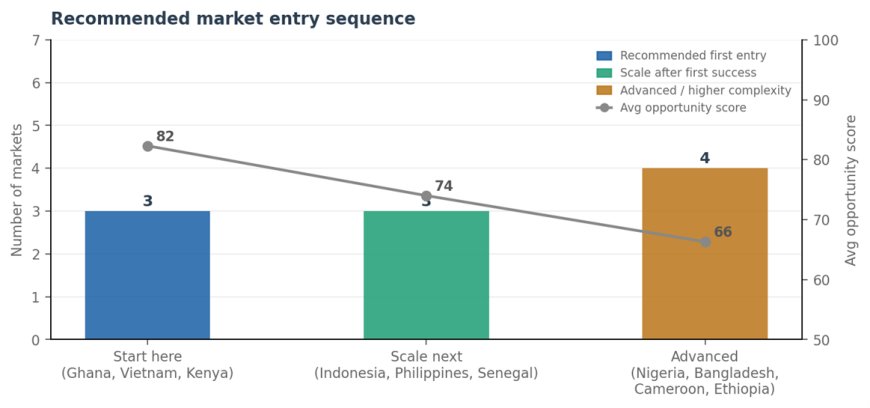
The four charts below summarise key data across all ten markets, composite opportunity scores ranked in article order, the recommended entry sequence, market complexity versus opportunity, and a multi-dimensional benchmarking of the top five markets.
|
Selection criteria |
Import growth · Macroeconomic stability · Trade infrastructure · Importer density · Regulatory openness |
|
Markets assessed |
10 across West Africa, East Africa, SE Asia & South Asia |
|
Recommended first entry markets |
Ghana, Vietnam and Kenya |
|
Highest-scoring market |
Ghana — Score: 84/100 |
|
Largest by import volume potential |
Nigeria — 220M+ population |
|
Highest GDP growth forecast (CAGR) |
Ethiopia — 7.7% |
CHART 1 — OPPORTUNITY SCORE BY MARKET (RANKED #1 TO #10)

Composite score based on the five ExporterIQ selection criteria. Nigeria's score is estimated; scores for unranked markets are derived from the article narrative and ranked order.
CHART 2 — RECOMMENDED MARKET ENTRY SEQUENCE

Three-tier entry framework based on ExporterIQ article guidance. 'Start here' tier (Ghana, Vietnam, Kenya) reflects the article's explicit recommendation for first-entry markets.
CHART 3 & 4 — COMPLEXITY VS OPPORTUNITY | MULTI-DIMENSIONAL BENCHMARK
|
|
|
|
Chart 3: X-axis = market complexity (higher = harder to enter). Bubble size = population. Dashed lines at score 75 and complexity 50. |
Chart 4: Radar benchmark across the five ExporterIQ selection criteria for the top five markets by opportunity score. |


Why Emerging Markets Are the Opportunity of the Decade
To understand why emerging markets matter so much right now, it helps to look at where population and economic growth are concentrated. The United Nations projects that by 2050, Africa alone will account for more than half of all global population growth. Southeast Asia's combined GDP is expanding at roughly three to four times the pace of Western Europe. South Asia, particularly Bangladesh, India, and Pakistan, is producing new urban consumers at an extraordinary rate.
This demographic and economic shift has direct consequences for trade. As urban populations grow and incomes rise, demand for imported goods, from food products to pharmaceuticals, from consumer electronics to industrial machinery, grows with them. Local manufacturing in many of these markets has not kept pace with consumption, which means the import gap is structural, not cyclical. It will not close quickly.
At the same time, digital infrastructure is transforming how businesses in these markets discover and evaluate foreign suppliers. B2B platforms, verified trade directories, and digital payment systems are reducing the friction of cross-border transactions. This makes it easier than ever for exporters to connect with verified importers in markets that were previously difficult to access.
How We Selected These Markets
Our selection is based on a combination of factors: import volume growth over the last three years, macroeconomic stability, trade infrastructure quality, the density of verified importers in the ExporterIQ network, and the openness of regulatory environments to foreign goods. These are not simply the largest economies; they are the markets where the conditions for successful B2B export relationships are most favourable right now.
1. Ghana - West Africa Score: 84/100
Ghana is consistently ranked one of West Africa's most accessible markets for foreign exporters. Its democratic stability, English-speaking business culture, and well-developed port infrastructure at Tema make it a natural entry point for the wider West African region. Import demand is strong across pharmaceuticals, consumer electronics, office supplies, food and beverages, and construction materials.
The Ghanaian middle class is expanding rapidly, particularly in Accra and Kumasi, driving demand for branded consumer goods and quality-assured products. Local importers are generally well-organised and experienced in international trade. Exporters who establish solid relationships with verified Ghanaian importers often find that these partners can facilitate introductions to neighbouring markets, including Togo, Burkina Faso, and Côte d'Ivoire.
Key watch points: Ghana has experienced currency pressure in recent years, so payment terms and hedging strategies matter. Working with importers who have established payment track records significantly reduces settlement risk.
2. Vietnam - Southeast Asia Score: 82/100
Vietnam occupies a unique position in the global trade landscape: it is simultaneously a major manufacturing hub and a fast-growing consumer market. Export-oriented manufacturing, particularly electronics, textiles, and footwear, has transformed Vietnam's economy over the past two decades, creating a large and growing urban workforce with rising disposable income.
For B2B exporters, Vietnam offers opportunities across several dimensions. Industrial importers are seeking high-quality machinery, components, and raw materials to feed their production lines. Consumer-facing businesses are importing food products, health and beauty goods, and household items for a population that is increasingly brand-aware. The country's young demographic profile, with a median age under 32, makes it particularly attractive for consumer goods exporters.
Vietnam's trade infrastructure is excellent by regional standards, with major ports at Ho Chi Minh City and Hai Phong handling large import volumes efficiently. The country has signed free trade agreements with the European Union and multiple ASEAN partners, which can simplify customs procedures for qualifying products.
3. Kenya - East Africa Score: 81/100
Kenya is the economic engine of East Africa and an increasingly important node in global trade flows. The Port of Mombasa is the primary gateway for landlocked markets, including Uganda, Rwanda, South Sudan, and the DRC, meaning that importers in Nairobi often serve as regional distributors for a market of well over 200 million people.
Kenya's business environment is sophisticated by African standards. A well-developed banking sector, strong mobile payments infrastructure (exemplified by M-Pesa), and a large community of experienced importers make it relatively straightforward to establish trade relationships. Priority import categories include pharmaceuticals, food commodities, industrial equipment, textiles, and technology products.
The Kenyan government has made significant investments in logistics infrastructure, including the Standard Gauge Railway connecting Mombasa to Nairobi and inland container depots. This is progressively reducing transit times and costs for importers in the region.
4. Nigeria -
Nigeria is Africa's largest economy by GDP and its most populous nation, with over 220 million people. For exporters willing to navigate its complexities, it offers unmatched scale. Import demand is enormous across virtually every product category, including consumer goods, industrial equipment, food products, chemicals, pharmaceuticals, and more.
Nigeria requires more careful preparation than most markets on this list. Currency management is a significant consideration; the naira has experienced substantial volatility, and payment terms need to be structured accordingly. Port congestion at Lagos can create delays, and the verification of local importers is especially important given the higher incidence of trade fraud in some segments of the market.
Despite these challenges, exporters who take the time to identify and build relationships with verified, reputable Nigerian importers consistently report Nigeria as one of their most valuable markets. The volume potential is simply too large to ignore, and the competition from other foreign exporters, while growing, remains lower than in more accessible markets.
5. Bangladesh
Bangladesh has built its economic reputation on textile and garment exports, but the import side of its trade balance tells a different and equally compelling story. The country imports enormous volumes of raw materials, machinery, and consumer goods to feed its manufacturing sector and its population of 170 million. Industrial machinery, chemicals and raw materials, electronics, and food commodities all feature heavily in Bangladesh's import profile.
Bangladesh's economy is diversifying beyond garments, with growing IT services, pharmaceutical, and light manufacturing sectors, each creating new import requirements. The country's improving port infrastructure at Chittagong is reducing logistics friction for foreign exporters.
6. Indonesia
Indonesia is Southeast Asia's largest economy and one of the world's most underappreciated consumer markets. With a population of over 270 million people spread across more than 17,000 islands, the country presents both extraordinary scale and logistical complexity. The Jakarta metropolitan area alone is home to over 30 million people, a market larger than many European nations.
Indonesia's rapidly expanding middle class is driving demand for consumer electronics, personal care products, food and beverages, and healthcare goods. Industrial demand is also strong as the government pursues an ambitious infrastructure development programme. Importers in Indonesia tend to be well-capitalised and experienced in international trade, though navigating the country's import licensing system requires careful preparation.
7. Senegal
Senegal is one of West Africa's most stable and promising markets, and one that many exporters overlook in favour of larger neighbours. Its political stability, favourable business environment, and position as a major Atlantic trade hub give it outsized strategic importance. The recent discovery of significant oil and gas reserves is accelerating infrastructure investment and creating new commercial activity across the economy.
Dakar's modern port infrastructure and its role as a gateway for Francophone West Africa make it particularly valuable for exporters seeking regional reach. Import demand is growing across food products, construction materials, consumer goods, and industrial equipment. French-language capability or partnerships with French-speaking agents are an advantage in the Senegalese market.
8. Cameroon
Cameroon serves as the commercial bridge between West and Central Africa, with Douala port handling import volumes not just for Cameroon's 28 million residents but for landlocked neighbours, including Chad and the Central African Republic. This transit role amplifies the effective market reach of importers based in Douala considerably.
Cameroon imports across a wide range of categories, including pharmaceuticals, food and beverages, chemicals, industrial machinery, and consumer goods. Its bilingual (French and English) business environment is unusual in the region and provides flexibility for exporters from both Anglophone and Francophone trading nations.
9. Philippines
The Philippines is often described as Southeast Asia's most consumer-oriented economy. A strong service sector, a large and English-proficient middle class, and deep cultural familiarity with Western brands and products create distinctive import demand. Consumer electronics, food products, cosmetics, personal care goods, and healthcare products are all high-demand import categories.
The Philippines also has one of the fastest-growing e-commerce markets in Asia, which is creating new demand from online retailers seeking to source imported consumer goods. The country's well-developed banking sector and established payment systems make transactional mechanics relatively straightforward for foreign exporters.
10. Ethiopia
Ethiopia is often described as Africa's sleeping giant, and it is waking up. With over 120 million people, it is the second most populous country on the continent. Its economy has grown rapidly over the past decade, driven by agricultural productivity gains, Chinese-backed infrastructure investment, and a growing industrial sector anchored around the Hawassa Industrial Park.
Ethiopia imports significant volumes of industrial machinery, chemicals, food products, and consumer goods. Its import market is less mature than Kenya or Ghana, which means the competitive landscape for foreign exporters is less crowded, but it also means that finding and verifying reputable importers requires more careful due diligence.
How to Prioritise Your Market Entry
With ten compelling options in front of you, the natural question is where to start. The answer depends on several factors specific to your business: your product category and its import demand profile in each market, your existing trade relationships and geographic knowledge, your capacity to handle documentation complexity, and your risk tolerance.
For most exporters entering emerging markets for the first time, we recommend starting with one market rather than pursuing multiple simultaneously. Ghana, Vietnam, and Kenya tend to offer the most accessible entry conditions, strong importer networks, manageable regulatory complexity, and relatively predictable payment environments. As you build experience and relationships in your first market, expansion into adjacent or complementary markets becomes significantly easier.
The most important single step you can take before entering any of these markets is to connect with verified, active importers. This is where ExporterIQ's role is most direct: our verified importer profiles across Africa, South Asia, and Southeast Asia give exporters a reliable starting point for outreach, eliminating the wasted time and risk that comes from working off unverified contact lists.
Emerging markets are not a monolith. Each of the ten markets we have profiled here has its own regulatory environment, cultural norms, logistics infrastructure, and payment dynamics. Success requires preparation, patience, and genuine investment in understanding your target market before your first shipment leaves the dock.
But the rewards for those who do the work are substantial. Exporters who establish trusted relationships in these markets now, before the competition intensifies, will have built structural advantages that compound in value over time. The window for early-mover positioning in many of these markets is open. The exporters who move through it decisively will look back at this moment as one of the defining decisions of their international growth story.











Comments (0)